

Astrology Crash Course
Marriage & Relationship Match Making
Learn kundali matching principles, compatibility analysis, dosha understanding, and remedies to guide marriages, relationships, and emotional harmony wisely across cultures worldwide.
Understanding Human Bonds & Compatibility Through Astrology
Marriage and relationships are among the most profound experiences in human life. They shape emotional well-being, personal growth, and long-term happiness. In Vedic astrology, marriage is not viewed merely as a social arrangement but as a karmic union between two souls. Marriage and relationship matchmaking astrology helps individuals understand compatibility, emotional needs, challenges, and the deeper purpose behind partnerships.
At Nabatara Institute, marriage and relationship matchmaking is taught with sensitivity, depth, and responsibility. Students are guided to understand relationships beyond fear-based predictions. Astrology becomes a tool for awareness, harmony, and conscious choice rather than judgment or anxiety.
Why Marriage Astrology Requires Deep Understanding
Marriage astrology is one of the most sensitive branches of astrology because it deals with emotions, expectations, and lifelong commitments. A careless interpretation can cause confusion or fear, while a balanced understanding can bring clarity and confidence. This is why learning marriage and relationship match making requires maturity, ethics, and proper guidance.
Students at Nabatara Institute learn that compatibility is not about perfection. Every relationship carries lessons, growth, and transformation. Astrology helps reveal how two individuals can support each other’s journey rather than promise an illusion of a conflict-free life.
The Role of Birth Charts in Relationship Compatibility
Every individual brings their own emotional patterns, communication style, and karmic baggage into a relationship. Birth charts reveal these tendencies clearly. Marriage match making astrology begins by understanding each person’s chart independently before comparing them together.
Students are taught to observe emotional needs, attachment styles, and expectations through planetary placements. This helps astrologers guide couples toward mutual understanding instead of blame. Relationship astrology becomes a mirror for self-awareness rather than comparison.
Understanding Kundali Matching Beyond Numbers
Kundali matching is often reduced to numerical scores, but true compatibility goes far beyond points. At Nabatara Institute, students learn that Ashta-Koota matching is a guideline, not a final verdict. Emotional maturity, planetary harmony, and timing play equally important roles.
Learners are trained to interpret kundali matching holistically. They understand when a lower score still supports harmony and when a higher score requires conscious effort. This balanced approach prevents unnecessary fear and supports healthy decision-making.
Emotional Compatibility and Mental Alignment
Emotional compatibility is the foundation of any lasting relationship. Astrology reveals emotional tendencies through the Moon, Venus, and relevant houses. Students learn how emotional patterns influence bonding, conflict resolution, and intimacy.
Mental alignment is equally important. Communication styles, expectations, and thought processes must complement each other for harmony. Relationship astrology helps individuals understand differences and navigate them with awareness rather than resistance.
Marriage Doshas and Their True Meaning
Marriage doshas are often misunderstood and feared. At Nabatara Institute, doshas are explained clearly and responsibly. Students learn that doshas indicate areas requiring awareness, balance, and effort, not permanent obstacles.
Rather than labeling relationships as doomed, learners are taught to understand the purpose behind doshas and how conscious choices and remedies can support harmony. This approach transforms fear into understanding.
Timing of Marriage and Relationship Stability
Marriage timing is a crucial part of relationship astrology. Students learn how planetary periods and transits influence readiness for commitment. Marriage is not forced by astrology; it unfolds when emotional maturity and karmic timing align.
This understanding helps astrologers guide individuals patiently, avoiding pressure or unrealistic expectations. Timing becomes a supportive guide rather than a rigid prediction.
Relationship Astrology for Modern Life
Modern relationships face challenges related to careers, long-distance commitments, emotional independence, and changing social dynamics. Marriage and relationship match making at Nabatara Institute addresses these realities with practical relevance.
Students learn to guide individuals navigating modern relationships without judgment. Astrology becomes a supportive tool that respects personal choice and evolving lifestyles across cultures worldwide.
Ethical Responsibility in Relationship Astrology
Relationship astrology requires compassion and discretion. Students are trained to communicate insights gently, respecting emotional sensitivity. Predictions are framed as possibilities rather than fixed outcomes.
This ethical foundation ensures that astrologers build trust and long-term credibility. Astrology becomes a source of support, not fear.
Understanding Marriage Doshas with Clarity and Maturity
Marriage doshas are often the most feared and misunderstood aspects of relationship astrology. Many people approach astrology already anxious about doshas, believing they automatically indicate failure, separation, or lifelong unhappiness. At Nabatara Institute, students are taught to understand doshas with clarity rather than fear. A dosha does not predict doom; it highlights specific karmic lessons that require awareness, balance, and conscious effort within a relationship.
Doshas arise when certain planetary energies create tension between emotional needs, expectations, or life paths. These tensions are not punishments but signals. When understood correctly, they help couples prepare mentally and emotionally for challenges. Students learn that doshas lose much of their intensity when individuals approach relationships with maturity, communication, and mutual respect. Astrology here becomes a guide for growth, not a verdict.
Manglik Dosha and Its Real Impact on Relationships
Manglik Dosha is one of the most widely discussed aspects of marriage astrology. Unfortunately, it is also one of the most misused. At Nabatara Institute, Manglik Dosha is explained with depth and realism. Students learn that Mars represents energy, drive, and assertion. When its energy is misunderstood or unmanaged, it can create conflict. When handled consciously, the same energy brings passion, protection, and strength to a relationship.
Learners are guided to evaluate Manglik Dosha in context rather than isolation. They understand when it truly affects marital harmony and when it becomes neutralized naturally through chart balance or mutual compatibility. This nuanced approach prevents unnecessary fear and supports informed decision-making.
Other Marriage Doshas and Compatibility Challenges
Beyond Manglik Dosha, there are several other combinations that influence marital harmony, including emotional imbalance, communication gaps, or mismatched life priorities. At Nabatara Institute, students learn to observe these patterns holistically. Rather than labeling a relationship as problematic, astrologers are trained to identify where understanding and adjustment are required.
Compatibility is not about sameness. Differences often create growth when approached consciously. Relationship astrology helps individuals understand where compromise is needed and where boundaries must be respected. This perspective allows astrology to support healthier relationships rather than impose rigid rules.
Remedies as Tools for Balance, Not Superstition
Remedies in marriage astrology are often misunderstood as quick fixes. At Nabatara Institute, remedies are taught as supportive tools rather than magical solutions. Students learn that remedies work best when combined with awareness and effort. A mantra, ritual, or practice helps align the mind and energy, but it cannot replace communication, patience, and emotional responsibility.
Learners are trained to suggest remedies ethically and sparingly. Remedies are used to strengthen positive energies and soften challenging ones, not to control outcomes. This approach builds trust and ensures astrology remains grounded and respectful.
Relationship Astrology for Emotional Healing
Not all relationship guidance is about marriage. Many individuals seek astrology after emotional pain, separation, or repeated relationship challenges. At Nabatara Institute, students learn how relationship astrology can support healing and self-understanding. Charts reveal patterns that repeat until awareness is gained.
By understanding these patterns, individuals can break cycles of unhealthy attachment and move toward balanced relationships. Astrology becomes a mirror that helps people grow emotionally rather than repeat the past unconsciously.
Timing in Relationships and Marriage Decisions
Timing plays a crucial role in relationship decisions. Students learn that entering or committing to a relationship at the right time supports harmony, while rushing during emotionally unstable periods often leads to conflict. Relationship astrology helps individuals recognize when patience is needed and when action is supported.
This understanding is especially valuable in modern life, where career pressures, long-distance relationships, and personal goals influence marriage timing. Astrology becomes a supportive guide that aligns personal readiness with cosmic timing.
Modern Relationship Challenges and Astrology
Modern relationships face challenges that traditional astrology texts did not address directly. Emotional independence, dual careers, digital communication, and shifting social norms influence relationships deeply. At Nabatara Institute, students are encouraged to interpret astrology in ways that respect modern realities without losing classical wisdom.
This balanced approach makes relationship astrology relevant for people across cultures and age groups. Astrology becomes adaptable, compassionate, and realistic.
The Astrologer’s Role in Relationship Guidance
Relationship astrologers carry a deep responsibility. Their words can influence decisions that affect entire lives. At Nabatara Institute, students are trained to guide rather than dictate. They learn how to present insights clearly while honoring personal choice.
This ethical grounding ensures that astrologers support individuals without creating dependency. Astrology becomes a source of clarity, not control.
Understanding Marriage Doshas with Clarity and Maturity
Marriage doshas are often the most feared and misunderstood aspects of relationship astrology. Many people approach astrology already anxious about doshas, believing they automatically indicate failure, separation, or lifelong unhappiness. At Nabatara Institute, students are taught to understand doshas with clarity rather than fear. A dosha does not predict doom; it highlights specific karmic lessons that require awareness, balance, and conscious effort within a relationship.
Doshas arise when certain planetary energies create tension between emotional needs, expectations, or life paths. These tensions are not punishments but signals. When understood correctly, they help couples prepare mentally and emotionally for challenges. Students learn that doshas lose much of their intensity when individuals approach relationships with maturity, communication, and mutual respect. Astrology here becomes a guide for growth, not a verdict.
Manglik Dosha and Its Real Impact on Relationships
Manglik Dosha is one of the most widely discussed aspects of marriage astrology. Unfortunately, it is also one of the most misused. At Nabatara Institute, Manglik Dosha is explained with depth and realism. Students learn that Mars represents energy, drive, and assertion. When its energy is misunderstood or unmanaged, it can create conflict. When handled consciously, the same energy brings passion, protection, and strength to a relationship.
Learners are guided to evaluate Manglik Dosha in context rather than isolation. They understand when it truly affects marital harmony and when it becomes neutralized naturally through chart balance or mutual compatibility. This nuanced approach prevents unnecessary fear and supports informed decision-making.
Other Marriage Doshas and Compatibility Challenges
Beyond Manglik Dosha, there are several other combinations that influence marital harmony, including emotional imbalance, communication gaps, or mismatched life priorities. At Nabatara Institute, students learn to observe these patterns holistically. Rather than labeling a relationship as problematic, astrologers are trained to identify where understanding and adjustment are required.
Compatibility is not about sameness. Differences often create growth when approached consciously. Relationship astrology helps individuals understand where compromise is needed and where boundaries must be respected. This perspective allows astrology to support healthier relationships rather than impose rigid rules.
Remedies as Tools for Balance, Not Superstition
Remedies in marriage astrology are often misunderstood as quick fixes. At Nabatara Institute, remedies are taught as supportive tools rather than magical solutions. Students learn that remedies work best when combined with awareness and effort. A mantra, ritual, or practice helps align the mind and energy, but it cannot replace communication, patience, and emotional responsibility.
Learners are trained to suggest remedies ethically and sparingly. Remedies are used to strengthen positive energies and soften challenging ones, not to control outcomes. This approach builds trust and ensures astrology remains grounded and respectful.
Relationship Astrology for Emotional Healing
Not all relationship guidance is about marriage. Many individuals seek astrology after emotional pain, separation, or repeated relationship challenges. At Nabatara Institute, students learn how relationship astrology can support healing and self-understanding. Charts reveal patterns that repeat until awareness is gained.
By understanding these patterns, individuals can break cycles of unhealthy attachment and move toward balanced relationships. Astrology becomes a mirror that helps people grow emotionally rather than repeat the past unconsciously.
Timing in Relationships and Marriage Decisions
Timing plays a crucial role in relationship decisions. Students learn that entering or committing to a relationship at the right time supports harmony, while rushing during emotionally unstable periods often leads to conflict. Relationship astrology helps individuals recognize when patience is needed and when action is supported.
This understanding is especially valuable in modern life, where career pressures, long-distance relationships, and personal goals influence marriage timing. Astrology becomes a supportive guide that aligns personal readiness with cosmic timing.
Modern Relationship Challenges and Astrology
Modern relationships face challenges that traditional astrology texts did not address directly. Emotional independence, dual careers, digital communication, and shifting social norms influence relationships deeply. At Nabatara Institute, students are encouraged to interpret astrology in ways that respect modern realities without losing classical wisdom.
This balanced approach makes relationship astrology relevant for people across cultures and age groups. Astrology becomes adaptable, compassionate, and realistic.
The Astrologer’s Role in Relationship Guidance
Relationship astrologers carry a deep responsibility. Their words can influence decisions that affect entire lives. At Nabatara Institute, students are trained to guide rather than dictate. They learn how to present insights clearly while honoring personal choice.
This ethical grounding ensures that astrologers support individuals without creating dependency. Astrology becomes a source of clarity, not control.
Step - 01
Fill The Form
Submit the admission form Properly with all the details.
Step - 02
Application Verification
You will receive a call from our team within 7 days.
Step - 03
Payment Processing
We will guide you through the payment process.
Step - 04
Successful Enrollment
You will be successfully enrolled in the course.



Crash Course Admission Form
Fill the form below to apply for crash course admission.

Explore Other Crash Courses

Gain clarity on planetary transits and dasha systems to predict life phases, opportunities, challenges, and turning points with precision timing accuracy.
Explore career paths, business potential, income timing, and financial stability through planetary strengths, dashas, and professional astrological analysis for global success.
Understand authentic planetary remedies, including mantra, yantra, gemstones, and rituals, to balance energies and reduce obstacles.
Practical Predictive Astrology Master real-life prediction techniques using dashas, transits, and timing methods to forecast events accurately and guide clients responsibly across situations globally.
Learn to understand planets, houses, signs, and charts clearly, building strong foundations for accurate readings and confident astrological interpretation in worldwide practice.
Short-term specialized courses for quick learning. Perfect for upgrading your skills in specific topics like Medical Astrology.
Why Choose Nabatara ?
Best Astrology & Tantra Institute in Kolkata, India
At Nabatara, we are committed to providing authentic, high-quality education in Astrology, Numerology, Vastu, Tantra, Yoga, and Meditation. Our courses are designed to help you understand the principles of these ancient practices and apply them to your daily life.
What Nabatara Offers?
-
Study real Astrology, Numerology, Vastu, Tantra, Yoga & Meditation.
-
Learn directly from spiritual teacher Gaurav Tribedi.
-
Students from many countries join our online & offline courses.
-
A government-registered institute offering credible spiritual education.
-
Real case studies, rituals, and step-by-step guidance.
-
On completion of the course, you will receive a certificate from Nabatara.


Govt. Recognition

Live Online Classes

Practical Sessions

Certificates & Awards

24×7 Support

Global Seminars
Client-06

Client-06

Client-06

Client-06

Client-06

Client-06

Receive Certificate Upon Completion
Upon successful completion of our crash courses in astrology, numerology, vastu shastra, and tantra, students receive an official certificate from Nabatara Institute. This certification reflects authentic learning, disciplined training, and practical understanding of ancient sciences. Recognized globally, it enhances professional credibility, builds client trust, and supports learners in establishing themselves confidently in spiritual and consultative fields worldwide.
 Become
a certified professional in Astrology, Numerology, Vastu
Shastra, and Tantra.
Become
a certified professional in Astrology, Numerology, Vastu
Shastra, and Tantra.
- Receive
an official crash course completion certificate after successful learning.
- Government
of India affiliated certifications ensuring trust and authenticity.
- Courses
available in English, Hindi, and Bengali for learner convenience.
- Experience
hands-on, practical training with real-life applications.
- Get
lifetime access after enrollment for continuous learning and growth.
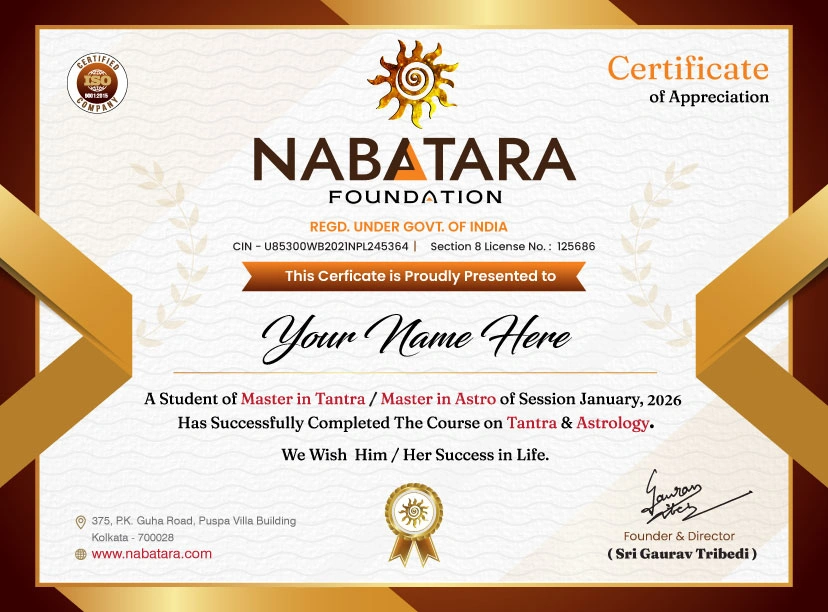
This globally recognized course completion certificate reflects authentic learning, Government of India affiliation, and practical mastery, empowering students worldwide to build professional credibility, attract clients confidently, and establish themselves as trusted practitioners in astrology and allied sciences.
Testimonials
What Our Students Say
Nabatara’s astrology course gave me deep chart clarity, prediction confidence, and spiritual grounding. The certification helped me attract genuine clients globally.

Beatriz Higuerey
Learning astrology at Nabatara transformed my understanding of birth charts, marriage matching, and career analysis. Practical teaching and guidance are truly exceptional.

Swastika Tribedi
This astrology course is authentic, detailed, and well-structured. I now practice confidently and guide people ethically with accurate predictions worldwide.

Swarnendu Bhattacharya
Nabatara Institute offers real astrological wisdom, not shortcuts. The course improved my skills, credibility, and professional recognition across different countries.

Dimpi Ghosh
Our Comprehensive Courses
At Nabatara, we offer government-affiliated and globally recognized programs.
Master the art of prediction with our comprehensive Vedic Astrology curriculum. Learn from basics to advanced techniques.
Discover the hidden power of numbers. Master name correction, mobile numerology, and logo vibration analysis to build a confident, client-ready professional practice.
Learn authentic Tantra Sadhana and Mantra chanting from Guru Gaurav Tribedi. A pure, spiritual path to empowerment.
Become a Certified Vastu Consultant. Learn remedial Vastu to correct defects without demolition for homes and offices.
Learn from anywhere in the world. Live interactive classes and notes. Same syllabus and certificate as offline courses.
Frequently Asked Questions
Why we are India's Best Astrology Institute
At Nabatara, we are committed to providing the best possible education and training in astrology, numerology, and related fields. Our team of experienced professionals is dedicated to helping you achieve your goals and improve your life.

Marriage and relationship matchmaking in Vedic astrology studies birth charts to understand compatibility, emotional bonding, karmic patterns, and long-term relationship harmony.
Marriage astrology focuses deeply on relationships, emotional needs, timing of marriage, compatibility analysis, and karmic lessons rather than general life predictions.
No. True kundali matching goes beyond Ashta-Koota points and includes planetary harmony, emotional compatibility, doshas, and timing of marriage.
Yes. Relationship astrology helps identify emotional patterns, communication gaps, and recurring challenges, offering clarity and guidance for conscious relationship choices.
Birth charts reveal emotional nature, expectations, attachment styles, and karmic patterns that strongly influence relationships and marriage outcomes.
Manglik Dosha indicates strong Mars energy. It is not always harmful and often becomes neutral through compatibility, maturity, or proper chart balance.
No. Marriage doshas highlight areas requiring awareness and effort. With understanding, communication, and proper guidance, their impact reduces significantly.
Marriage timing is crucial. Astrology helps identify when emotional readiness and planetary support align, improving stability and harmony in relationships.
Yes. Modern relationship astrology considers careers, long-distance bonds, emotional independence, and changing social dynamics with practical relevance.
Remedies support emotional balance and awareness but are not magic fixes. They work best when combined with maturity, communication, and conscious effort.
Nabatara Institute teaches marriage astrology ethically, without fear-based predictions, focusing on awareness, responsibility, and real-life relationship guidance.
Yes. This course benefits astrologers, relationship counselors, healers, and students seeking deep understanding of compatibility and emotional dynamics.
Yes. Astrology helps identify repeating patterns, emotional wounds, and karmic lessons, supporting healing and healthier future relationships.
The course is guided by the wisdom of Gaurav Tribedi, known for compassionate, ethical, and practical astrology education worldwide.
Nabatara Institute is trusted globally for structured astrology courses, ethical teachings, modern relevance, and deep understanding of relationship compatibility.